
Creative Hubs & Labs

best practices
Exciting labs

Körber Innovation Hub
The Körber Foundation will create an "Innovation Hub" (working title) at its main location in Hamburg's HafenCity. She wants to support young social entrepreneurs, especially in the critical phase between concretizing the first idea and the concrete business plan. The Innovation Hub wants to provide impetus, impart skills and facilitate contacts. In this way, the foundation wants to create strategic links with civil society initiatives and organizations in Hamburg and strengthen the role of civil society in solving social problems.
As matrix, we accompany the concept development and are very happy about this exciting cooperation with Carmen Ludwig, head of the Innovation Hub.
3 questions for Carmen Ludwig:
Dear Carmen Ludwig,
where does the Körber Foundation stand at the moment when it comes to the Innovation Hub?
We are currently in the middle of the development process, but we are absolutely on schedule: we will start with the first formats at the beginning of 2023 and the area will be ready for occupancy in autumn 2023. We design the development process with the relevant stakeholders from Hamburg, because we want to create added value for the area of social entrepreneurship with the hub and dedicate this place in particular to young people.
What are the biggest challenges at the moment?
The topic and the target group have so much potential that sharpening the profile is not that easy. Another challenge is that the target group is very heterogeneous and we therefore have to create as diverse an offer as possible in order to meet the needs - but that is exactly what makes this job so appealing.
Where do you see the greatest opportunities?
It is an incredible opportunity to be able to create and design a new place. I see the cooperation with the partners as a great enrichment and it brings many important impulses - also for our work as an operational foundation. The fact that in future we will be dedicating ourselves to the topic of social entrepreneurship and social innovation with the target group of young people in the hub is ultimately a reflection of our DNA.
Quick Facts Körber Innovation Hub
| Name | Körber Innovation Hub |
| Location | Hamburg |
| Categories | Innovation and start-up center |
| Target groups | young social entrepreneurs |
| Objective | Funding in the critical phase between concretization of the first idea and the concrete business plan |
| main emphasis | Social Entrepreneurship & Social Innovation |
| founding year | Opening autumn 2023 |
| Supporting organization | Amber-Stiftung |

Textile Prototyping Lab, Berlin
In 2017 the Textile Prototyping Lab (TPL) was founded as a research project. After five years, it is now in the transition to legal and economic independence. The solid foundation for this has been laid. There are now a wide range of tried and tested offers for the defined target groups: Young talents can implement their own ideas in the TPL. Professionals such as design offices, smaller companies, self-employed people with practical experience, as well as industrial and medium-sized companies develop textile prototypes here. Sometimes these are companies that come from the textile industry, but sometimes they are also companies that want to improve current products with textile solutions. The ways in which the lab is used are very different: from individual workshops and lectures lasting several weeks to the use of individual machines (after thorough technical instruction) to the assignment of a complete development contract to the lab team. The cooperation partners share resources and know-how for this - this is the indispensable basis of the lab.
In addition, the lab sees itself as a transfer location and educational institution. For example, the TPL has worked with student groups on projects that were formed through competency mapping. This resulted in several foundations.
During the construction phase of the TPL, the following aspects have proven to be critical to success:
- Successful methods of collaboration in multidisciplinary consortium
- Development of various tools, from the multi-stakeholder management tool and the material library to the modular system with electronic modules, which also make it easy for technical laypeople to develop digital prototypes
- Case studies for different target groups in order to create different offers
- Networking
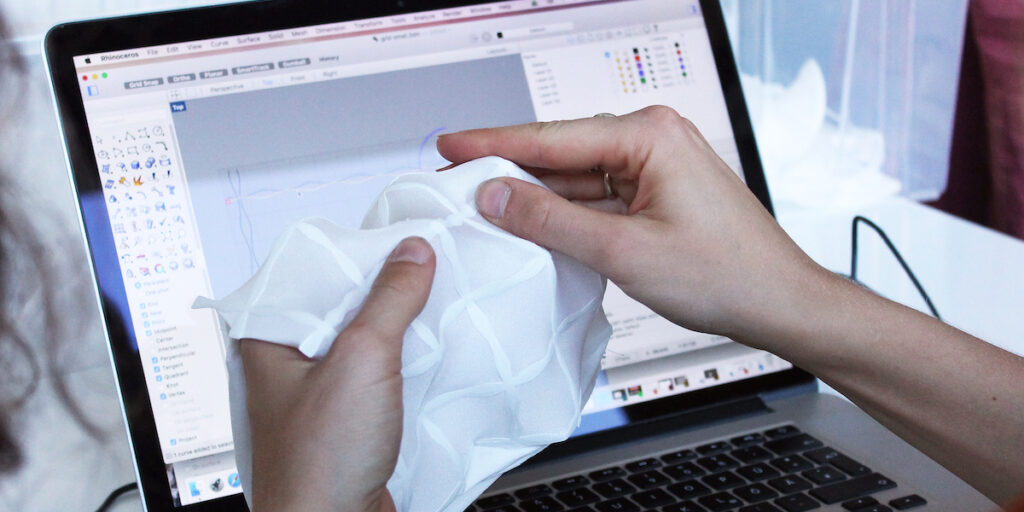
We wish the TPL continued success on its way to becoming an independent lab in the lively innovation ecosystem. Many thanks to Essi Johanna Glomb, Weissensee Kunsthochschule Berlin, and Sigrid Rotzler, Fraunhofer Institute for Reliability and Microintegration, for the exciting conversation that we had as the basis of this article. You can find out more about the Textile Prototyping Lab here: Textile Prototyping Lab.
Quick Facts Textile Prototyping Lab, Berlin
| Name | Textile Prototyping Lab |
| Location | Berlin |
| Categories | Innovation and Research Lab |
| Target groups | 1. Young Talents, 2. Professionals, 3. Industry, SMEs |
| Objective | Creation of an open, agile, interdisciplinary place for textile prototyping |
| main emphasis | Open Innovation |
| founding year | 2017 |
| Supporting organization Other Partners | Weißensee Kunsthochschule Berlin, Fraunhofer Institute for Reliability and Microintegration Textile Research Institute Thuringia-Vogtland eV, Saxon Textile Research Institute eV, Prototypes for Europe |
| Sponsored by | zwei20 – Partnership for Innovation, Federal Ministry of Education and Research as part of the Future TEX project |
Lessons learned
Experiences & Recommendations
Principles for openness in science and innovation
InnOsci is a project of the Stifterverband, which was carried out from 2019 - 2022 with the support of the Federal Ministry of Education and Research (BMBF) with the aim of bringing together actors from science, business, civil society and politics. InnOsci served as a forum for an open culture of innovation and a platform for the joint development of instruments for innovation and social transformation. The following lessons learned were formulated as principles for openness in science and innovation:

1|6 Collaboration and co-creation
Actors from different disciplines and sectors work together in knowledge creation and design processes and can thus develop better and more widely accepted solutions.
2|6 knowledge and information sharing
Making knowledge and information available and exchanging it on both sides is a prerequisite for opening up science and innovation.
3|6 inclusion and participation
All potentially affected groups and stakeholders, especially minorities, are integrated into knowledge creation and design processes.
4|6 Multidisciplinarity
By integrating different disciplines and approaches, blind spots are to be avoided and holistic problems are to be better solved.
5|6 Orientation towards the common good
The opening of science, and increasingly that of innovation, and the knowledge gained with it should benefit the common good. Open science and innovation thus make a significant contribution to solving the challenges of our society – such as digitization, sustainability or mobility.
6|6 willingness to experiment
Openness includes continuous testing and learning, courage to act, taking risks and also allowing mistakes.
matrix gGmbH is an active member of the Stifterverband and works with the association on joint projects such as the nationwide initiative MINTvernetzt.
Financing & funding
ERDF/JTF program NRW - Good chances for innovations

at the event “Making the future – shaping transformation”
There will soon be many opportunities to foster innovation locations and innovation ecosystems. This became very clear on Friday, September 9th, during the event “Making the Future – Shaping Transformation”. The entire ERDF/JTF program NRW 2021-2027 was presented with its key data. It comprises a total of 4,2 billion euros.
We found the innovations that Silke Krebs, State Secretary in the Ministry of Economics, Industry, Climate Protection and Energy of the State of North Rhine-Westphalia, explained, particularly interesting. They will speed up the award process and significantly simplify the management of the funding program:
- There will be several set-up periods over the term.
- The entire process is digitized. Finally, this process will be possible without media discontinuity with a single data entry.
- Flat rates for material and personnel expenses will greatly simplify the management and accounting of the funded projects.
This is really good news from our point of view!
The call for Regio.NRW is scheduled for November 2, 2022. Regio.NRW promotes regionally effective projects that strengthen cooperation structures and increase regional competitiveness and innovative strength through knowledge and technology transfer. This applies in particular if the projects use the diverse regional potential, are model/pilot projects or significantly expand existing fields of action and make a contribution to location development. Applications can be submitted by regions with at least three districts/cities or at least one million inhabitants.


Within the framework of JTF NRW, technical and organizational infrastructures in which start-ups, SMEs, scientific institutions and universities jointly validate innovative research results and technologies and put them into commercial use are funded. In addition, the construction and equipping of appropriate centers, for example with systems, tools or laboratory space, is funded. The focus is on growth areas related to Green Deal and digitization. One focus is on project funding in the Rhenish mining area/northern Ruhr area (Bottrop, Dorsten, Gladbeck and Marl).
The ERDF.NRW call for proposals in the field of circular economy approaches and in the field of promoting young people also offers exciting approaches.
When building and evolving innovation venues, innovation ecosystems and extracurricular learning venues, we think well beyond the visible and invisible walls of physical spaces and disciplines. Therefore, this funding approach fits particularly well with our approach to the development of these places.
Overall, the event was very well attended, offered a great atmosphere with excellent opportunities to network. We made good use of them. Thanks!
It should have more information here shortly: https://www.efre.nrw.de/wege-zur-foerderung/projektaufrufe/regionrw-2-aufruf/
Strategies, Studies & Research

The design of innovation spaces is
NRW politically funded.
Innovation strategy of the state of North Rhine-Westphalia
First of all, it is important to state that the state's concept of innovation also includes innovations in the social economy and is therefore intended to promote not only universities, research institutions and companies but also other social actors such as volunteer operators of makerspaces in their innovation activities. This also goes hand in hand with the fact that innovations are of course not always of a technological nature and, for example, social innovations and product developments in the service sector sometimes require different support than technical and industrial topics.
In the field of action "Intensify networking", the promotion of clusters, hubs and innovation networks, in addition to the exchange and transfer of knowledge, is an essential component. International orientation and synergies in the Germany-wide innovation network are expressly desired by the state. The real laboratory approach for transformation processes such as in the Rhenish Revier and in the Ruhr Metropolis should also be applied nationwide.
In the area of open innovation, agile participation formats in companies should enrich product development and strengthen cooperation between actors from research and the private sector.
Quote innovation strategy, p. 53: “We want to give open innovation further impetus. Examples are the connection of maker or co-working spaces with open innovation platforms, creative laboratories or the support of cooperation between start-ups and established small and medium-sized companies. We want to expand the existing offers with a funding program to create platforms for cooperation and collaboration.”
The universities play a particularly important role in the creation of local innovation ecosystems as part of the "Start-up Transfer" funding measure, because "innovation laboratories" at universities are also to be explicitly funded.
Future contract for NRW
If you want to build or further develop innovation ecosystems, we would like to highlight the following starting points in the new coalition agreement of the state of North Rhine-Westphalia:
- Development of a real laboratory for citizen participation for structural change in the Rheinisches Revier coal region (p. 16)
- Industry: National Innovation Hub for Plastics Recycling (p. 21)
- Vocational training: Planning of innovation laboratories at vocational colleges in cooperation with the chambers (p. 65)
- Extracurricular education: zdi network with student laboratories and expansion of programs in the field of education for sustainable development (p. 66 – 67)
- Other thematic research institutions and competence centers that can be designed as a hub (example: artificial intelligence)
- Strengthening the innovation ecosystems for social innovations (p. 73)
- Start-up funding: Expansion of the "DWNRW hubs" for start-ups as regional networks (p. 73)
- New forms of housing for trainees and students (p. 113) – here we as matrix are already working on the concept development for a trainee campus at one location
- Spaces for innovation and experimentation for creative people (p. 124) – Funding for interim use of empty buildings, among other things
These political framework conditions offer the space for exciting formats to promote co-creation in a wide variety of subject areas and show that an economic and social transformation should be guided by participatory spaces. The Creative Hubs & Labs team at matrix is currently in the project development phase of innovation spaces on various topics, which will also contribute to the country's future strategy.
New Work as a savior?
Expert study by Brugger, Teichert, Neumann, Dodt
The authors understand New Work as a possible solution strategy for the shortage of skilled workers. From this perspective, they pose questions in the study about the understanding of New Work, about the obstacles and challenges of implementation and about the requirements that arise for management and the organizational model. A total of 137 people in different roles, industries and sectors were interviewed. When it came to the obstacles to the introduction of the New Work principle of “self-responsibility”, for example, the topic of “fear” was high up. The study then provides recommendations for action. The study follows this logic for all New Work principles. In conclusion, the authors come to the conclusion that New Work can be a good lever for productivity and employer attractiveness, but the introduction must be embedded in social, cultural, economic and scientific contexts.

Tools, methods & typology
Design an innovation lab for a region
Checklist part 3: Operating model and financing concept

A new place of innovation is to be created in the region, but for what exactly?
There is already an idea and funding is available, but how exactly should the Innovation Lab be designed?
Didn't pay attention at the right moment in the meeting and now you're supposed to be planning an innovation lab?
Our checklist for designing innovation labs provides orientation and helps to structure the planning work. However, this is not a linear process: Previous results have to be accessed again and again, checked and adjusted if necessary.
In addition, a participatory process should be aimed for, in which the questions are worked on together with the project partners, stakeholders and, above all, the target groups. This is the only way to create a place that is geared to the actual needs of the region and that can deliver real added value for the innovation ecosystem.
The checklist is divided into five parts:
- Part: Strategic positioning and target image
- Part: usage concept
- Part: operating model and financing concept
- Part: Spatial concept and equipment
- Part: implementation and testing
Based on the strategic positioning described in parts 1 and 2, the target image and the usage concept, part 3 is about developing the operating model and the financing concept.
Part 3: Operating model and financing concept
- What are the expected costs?
It is about first identifying the relevant types of costs such as personnel costs, operating costs, investment costs and breaking them down. The amount of the costs depends primarily on the developed usage concept and the room concept and the equipment (part 4 of our series). - What contribution to costs or income do the individual offers and programs make?
Again based on the usage concept, it should be estimated which offers could be carried out how often, with which staff and which equipment, what specific costs would arise and what income could be generated. This look into the crystal ball is of course initially about a rough estimate in order to get a feeling for possible total volumes and the connections between supply and costs or income. - What staff is required?
There are often already commitments in regions for investments or advanced construction projects that are to be put to use. When it comes to staff planning and staff funding, things tend to look rather thin. In our experience, however, the right staff is crucial for success. Especially when building and establishing the innovation location, people are needed who are passionate about the idea and able to transfer their enthusiasm to potential partners. Accordingly, sufficient staff positions should be planned for the network work, which is important at the beginning, but also for the other fields of activity. - What can different financing models look like?
When it comes to financing, the various models always range between private financing and economic orientation and public financing and non-profit orientation. In practice, mixed models are the rule. It is important to plan various sources of income that ensure basic financing, but also to plan for income from unusual offers, for example through business partnerships. At this point at the latest, the sticking points often arise in the feasibility studies and important strategic decisions have to be made, which are then often associated with the question of sponsorship. - What does this mean for the support structure?
In addition to the question of the legal form and the corresponding construction of the support structure, it is essential which institutions are able and also promise to be involved in a support structure. In addition to public institutions, foundations and companies are also important sponsors who should not only contribute financially, but also in the strategic design. Therefore, the support model should be designed in such a way that smooth business operations are possible, but a broad integration of the different target groups and partners in the support model is made possible, thus ensuring the acceptance and sustainable design of the innovation location. - Who runs the place?
The actual sponsorship of the innovation location is initially detached from the operator question. Ownership and operation do not necessarily have to be in one hand. When constructing the operating model, it is important to ensure access for the target groups, partners or third parties. - What can different expansion stages look like?
As a rule, various expansion stages should be planned for the first few years. Even before the completion of buildings, the preparatory work or even the first activities, such as test offers (see part 5), should be started. The distribution of the investment costs over the first few years must be closely coordinated with the usage concept. - Check suitability for current and upcoming funding programs.
It is necessary to examine how the individual stages of development can be supported by possible funding programs. As a rule, the entire project does not have to be funded, so individual funding modules should be planned. In addition to clustering according to investments or the didactic development of formats, for example, a distinction should also be made between start-up financing in the development phase and possible funding, for example through specialist programs or R&D projects in the operation of the innovation location.
Part 4: Room concept and equipment in the next newsletter 5|22 …
People & Projects of matrix

"I want to make a difference. "
Hi Anna,
you are an expert in the development of technology and start-up centers. You have been a consultant at matrix in the Creative Hubs & Labs department since the beginning of August. Warm welcome!
What is happening in this exciting field of technology and start-up centers?
For a long time, start-up and technology centers were closely tied to a funding logic that primarily ensured that space was rented without always paying close attention to who was moving in and whether such an innovative environment could develop. Today, the funding focuses much more on the fact that synergies can arise between founders, start-ups and established companies that come together. Ideally, there will also be a university and a vocational school as well. When set up correctly, an entire innovation ecosystem develops, which is linked to other facilities such as a FabLab or a MakerSpace.
You've been with the matrix since the beginning of August. What made you come to the matrix?
I particularly like the fact that very different people from different areas with very different qualifications work here. They bring very different perspectives: from the industrial designer, the product designer to the economist, the geographer to the communication expert. Everyone can contribute their strengths and experience here. It is a very good team working on this subject area Creative Hubs & Labs. The matrix has also taken up the cause of rethinking the topic of innovation centers together with partners. I find that super exciting. And the connection with STEM education at matrix also offers many opportunities. How can you bring innovation and founding to the students early on? This is a very exciting and demanding task.
What skills can you contribute here?
I come from the "classic" economic development consultancy. One focus of mine was the development of start-up and technology centers. I have several years of experience here, also far beyond NRW. I covered the whole range: from the new concept to the evaluation. I can put my knowledge of business administration to good use here. The topic of innovation is really important to me, because that's the only way we can advance the location and society as a whole. I want to make a difference. That's why I fit in well with the matrix.

Liebe Anna,
what do you do when you are not working?
When I'm not working, I'm out on my mountain bike or in the woods with my dog. We also do short distances in threes 😊.

Digital manufacturing technology in one emerging
The FabAcademy in Jordan as an opportunity provider
Adriana, matrix's expert for FabLabs, digital prototyping and smart textiles, has just returned from Jordan. She is also an instructor at the FabAcademy and has accompanied her on-site study group at the Crown Prince Foundation's FabLab TechWorks.
Jordan? What are the benefits of a FabLab in Jordan? What is the FabAcademy doing there? Jordan is a country with an extremely heterogeneous population in terms of social aspects and education. TechWorks, on the other hand, is open to everyone. Here people who want to learn can deal with digital manufacturing processes and modern production technologies without formal education. In the FabLab you will find the necessary technology, qualified support from specialist staff and exchange in the community. According to the FabLab motto "How to make (almost) anything", they experience self-efficacy and develop further. This opens up completely new opportunities for them. In addition to this individual level, the FabLab wants to initiate foundations in Jordan and creates the opportunity to change society. Because projects by FabLabs have a direct impact on the local environment, such as Amin Yousef's project, who developed a 3D-printed hand prosthesis for total mobilization of the hand, or Suha Mohammad Al Habashneh's Water-Saver project, which is based on it aims to save water when filling tanks, one of the biggest problems in Jordan, the country with the second greatest water shortage in the world.
What role does the FabAcademy play in this? And how does it work? The FabAcademy is the FabFoundation's global continuing education program and is led online by Neil Gershenfeld, Professor and Director of MIT's Center for Bits and Atoms. In an intensive and strictly scheduled 16 weeks, the study groups acquire skills from computer-aided design (CAD) and electronics design to 3D printing. During the entire training period, they implement their projects in a practical way in a FabLab, with local support from an instructor and access to a platform with a globally networked community and interactive video lectures. The participants go through all phases of a development project using digital manufacturing technologies by working on a small project related to the topic every week. For example, one of the groups (task class) is mechanical and machine design. Here the FabLab TechWorks group has developed a clay sculpting machine, a 4-axis CNC designed with the aim of sculpting clay into figures that cannot be made by human hands, and industrial crafting with clay in a quick process to reinterpret.


Finally, they implement their individual, self-designed project and also qualify in project management. At the end, participants can then independently carry out and manage digital production projects in a FabLab. Many of these participants later become instructors themselves and carry on the spirit of the FabLabs or even found their own labs, as three of Adriana's participants did this year. It was the same with Adriana herself. She graduated from the FabAcademy in 2016. Since then she has been passionate about the idea and has already implemented numerous projects. She is currently leading the shemakes.eu project on behalf of matrix and is part of the MakeOpaedics project. But now she is particularly excited about the graduation of her study group in Jordan. I wish you success!

Craft meets co-creation
The historic Waidhaus in Görlitz was used in the past as a competence center for further training for craftsmen of various trades in the field of monument restoration. The development company Niederschlesische Oberlausitz mbH has now started a process for the further development of the center with an international orientation in the local border triangle of Germany, Poland and the Czech Republic and commissioned matrix with a feasibility study for the new concept. The target group includes not only interested craftsmen: inside, but also the citizenry and tourist visitors: inside. The tradition of restoration should be made visible to the general public with exciting co-creative approaches and create agile forms of learning and thus the first modern innovation place for monument preservation.
3 questions for Benedikt M. Hummel, Mayor for Culture, Youth, Schools, Sports, Social Affairs, Building and Urban Development of the City of Görlitz.

Can you please briefly summarize the project from your point of view? Why is?
In the Görlitzer Waidhaus, the oldest surviving secular building in the city, the German Foundation for Monument Protection ran a monument academy for more than twenty years, in which a craftsman's training course for "restorers in the craft" was run by the Görlitzer Training Center for Crafts and Monument Preservation eV.
The tradition of teaching traditional craft techniques for the renovation and restoration of monuments is now to be continued in a sustainable manner. Face-to-face and online formats are to be developed and used for this as required. The impact of the project includes local, regional and international levels and will place a special focus on the border triangle Germany-Poland-Czech Republic. School and tourism formats ensure that the information can also be conveyed by third parties in an appropriate manner and that it reaches professional customers and laypeople alike. In this sense, the Görlitz "Competence Center for Craftsmanship in Monument Restoration" is intended to make a lasting contribution to the care and communication of national and international cultural heritage.
What are the challenges? What opportunities do you see?
In practically every federal state there are one or more 'monument centres' which deal with different concepts for the maintenance and restoration of monuments. The challenge is that there is no adequate commercial or educational market for the automatic maintenance of the centers. Chambers of crafts regularly support the respective concerns or are even involved in the financing, but see no possibility of integrating the complete canon of restorer training into the standard craft training. On the other hand, there is a lack of economic motivation for post-qualification, since the proportion of manual work in monuments is comparatively marginal almost everywhere.
Due to the outstanding inventory of around 4.000 monuments, Görlitz was and is a disproportionate market, which on the one hand is not representative, but on the other hand is ideally suited as a place for restoration training courses in the future. The development of a network with comparable providers, which goes hand in hand with the project development, ensures that synergies are used and competition is avoided.
What is the significance of the project and the Waidhaus for the city of Görlitz?
The unique density of monuments from different eras, which characterize the townscape of Görlitz, represents an essential and valuable asset for the town, which must be preserved. The creation and transfer of intellectual capital and technical skills in the preservation of monuments is therefore of considerable importance. For this reason, establishing a center for this exchange of knowledge in our city seems logical and also coherently anchored at the location of the Waidhaus in the heart of the city.

You think about the structure
or the further development of an innovation hub?
Save the date
17.09.22
25.-27.09.22
28.-29.09.22
12.-22.10.22
15.-16.11.22
